Mario Karty Party
A board game that turns Mario Kart into a turn-based race for two to four players. Four of us designed it, and I built and tested the playable version in Tabletop Simulator.
- Role
- Game designer, prototype builder and lead playtester
- Team
- 4 people
- Course
- Game Design Process, Game Development, Centennial College
- When
- First Semester, Fall 2024
- Requirements
- A non-digital tabletop game built around an existing IP or a local theme
- Players
- 2 to 4
- Length
- About 30 minutes
- Tools
- Tabletop Simulator, Google Docs
- Result
- A+ in the course
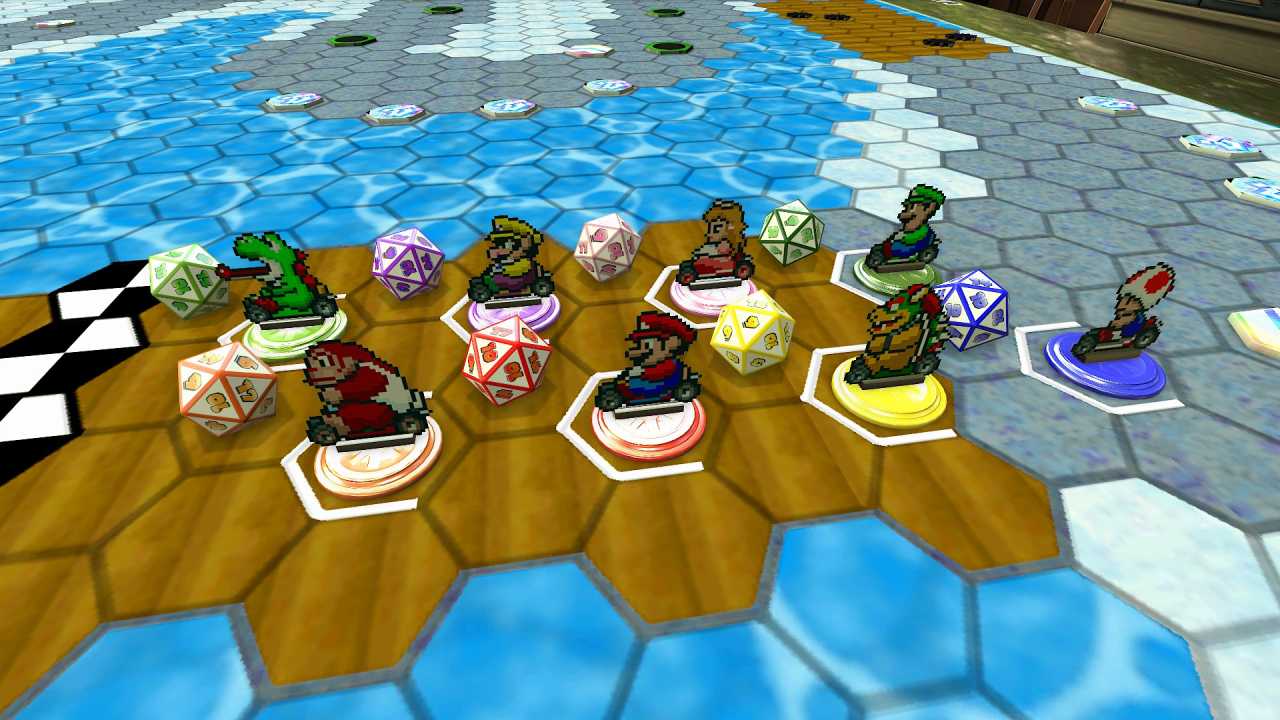
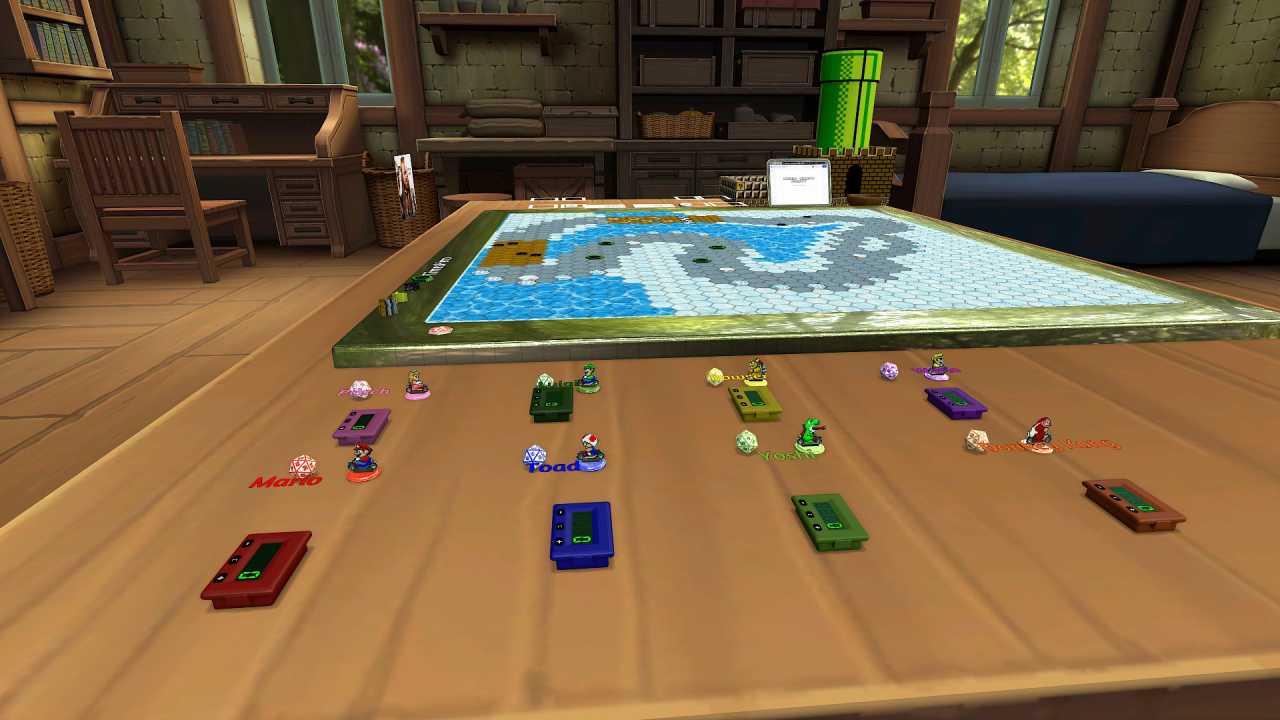
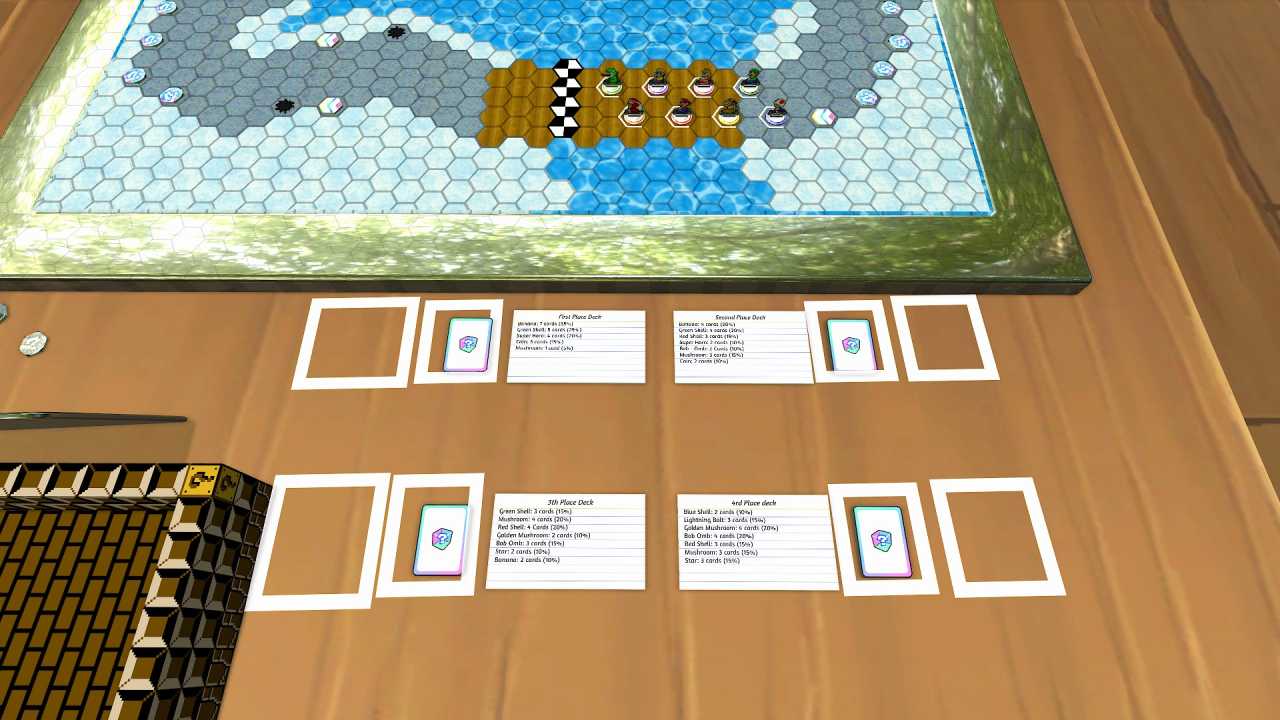
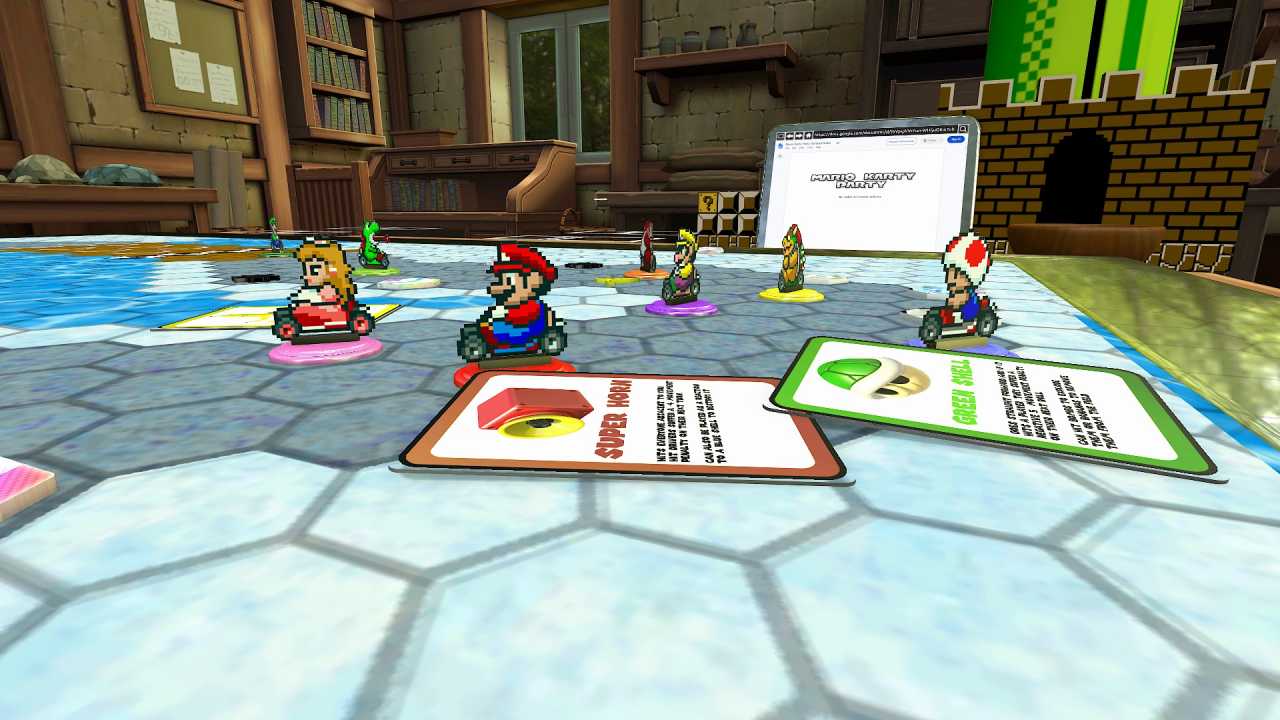
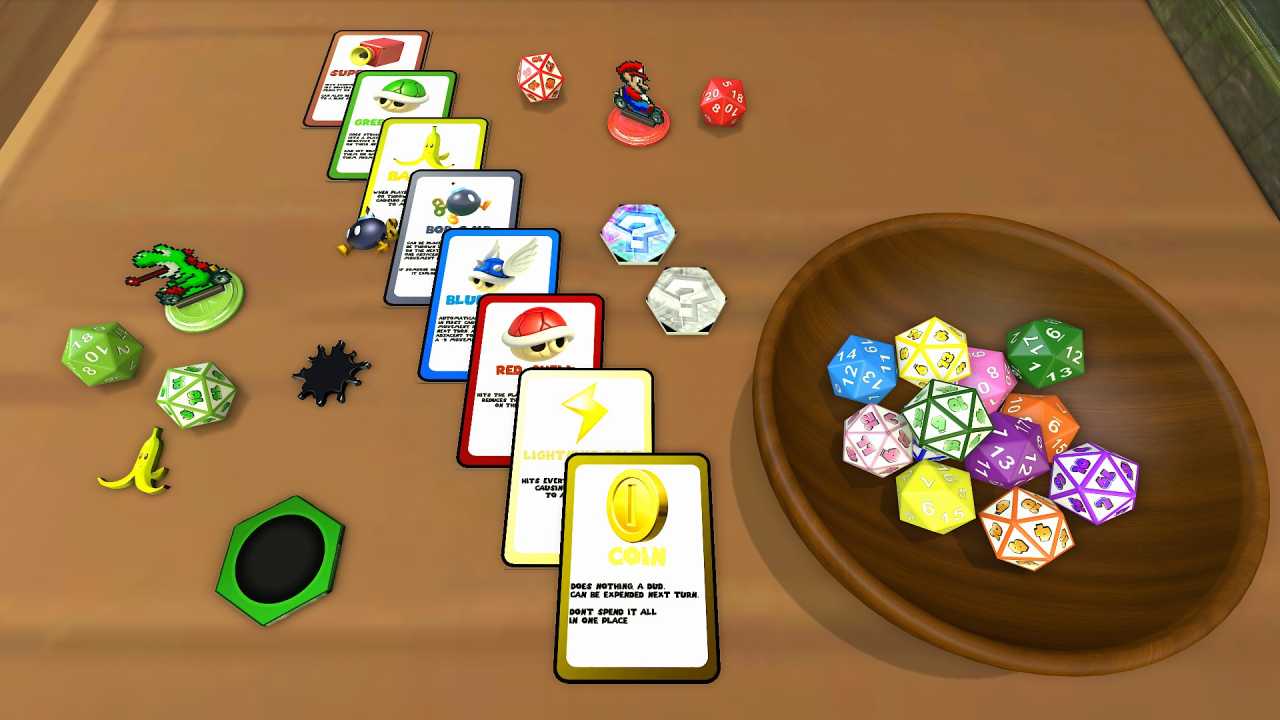


- Built the whole game as a playable Tabletop Simulator table: the track, eight character pieces, eight custom 20-sided dice, four 20-card item decks and every token.
- Ran four playtests, two of them with players from outside the team. The assignment instructions only required two.
- Cut the game from three laps with D6 dice, where one lap took 30 minutes, to a full race in about 30 minutes with character specific D20s, item cards, and a smaller map.
- Each character has a die with a similar average and a different level of risk.
- The rubber-banding both Mario Kart and Mario Party are known for is built into the item decks. The further back you are, the stronger the cards you draw.
- Finished the course with an A+.
The project
The assignment was to design a tabletop game around an existing IP or a local theme, test it with players, and improve it from their feedback. We chose Mario Kart. The design problem was turning a real-time racing game into something that works one turn at a time and still feels like the original: fast, a little unfair, and decided by items.
Players pick a character, roll that character's die to move around a hex track, and draw item cards from boxes along the way. The first to finish two laps wins.
What I owned
- Building the game in Tabletop Simulator, so four people could play it from anywhere without printing anything.
- Choosing and importing every asset: the board, pieces, cards and tokens.
- Making the eight character dice, each with custom art and its own set of 20 values.
- Rebuilding the table after every round of changes, and testing it before the team played.
There's no scripting in it. Every piece is placed and moved by hand, the way it would be on a real table.
How we worked
We played and noted what dragged or confused people, changed the game, and played again.
- Playtest 1, the team. The game was far too long. We shrank the map, went from three laps to two, moved item boxes to the edges of the track, rebalanced the dice, and added track hazards.
- Playtest 2, the team. The length felt right, and players were chaining items and trapping routes with bananas. The start and end of the track were dull, so we moved boost pads outward and added more near the start line.
- Playtest 3, one outside player. He understood most of the rules from the page, but a few card interactions weren't written down. We reworded five cards and the dash panel rule.
- Playtest 4, two outside players. They raised questions about turn-order advantage, the width of the dice ranges, and how to judge race position when two karts are side by side.
One hard decision
Coins are part of Mario Kart, and the team wanted them because of how if you collect them, you move faster. We worked through what would happen. The player in first reaches every coin first, gets faster, and pulls further ahead. In a game built around catching up, that would have undone the item decks. We kept the coin as a card that does nothing, which makes drawing from the first-place deck a small gamble.
Outcome
- A complete game with a rulebook, eight characters, eleven items and one track, Aurora Lakeside.
- A full race in about 30 minutes, down from 30 minutes for a single lap.
- A table anyone with Tabletop Simulator can load and play.
What I'd do differently
I'd put the rules in front of outside players sooner. The first two playtests were the four of us, and we all knew how the game was meant to work. The gaps in the wording only showed up when someone had to learn it from the page.
I'd keep one master list of the numbers. Going back through the table for this write-up, I found dice and deck lists that had drifted from the rulebook between versions.
I'd also check every number before building with it. The dice came from a professor-recommended language model and nobody added up the faces, which is covered below.
Very different dice
Every character rolls a 20-sided die, and no two are the same. Our first set had characters that were simply better than others. The fix was to give every die an average of about 10 and change how far it swings.
Toad's faces run from 5 to 14, with seven 10s. He never has a terrible turn and never a great one. Wario's run from 1 to 20, with two 20s. He can cross half the track or go nowhere. Picking a character becomes a choice about how much luck you want.
Checking the dice afterwards
Our professor suggested trying ChatGPT as a design tool, so we asked it for eight sets of 20 values that all averaged 10, with the spread modelled on Mario Kart's trade-off between acceleration and top speed. We took the numbers and built the dice.
When I wrote this page I went back and added them up. The averages run from 9.70 for Toad to 10.90 for Wario. Yoshi's die matches or beats Toad's and Peach's on every face, so nobody has a reason to pick either of them. In a simulated eight-player race on dice alone, Wario wins about a third of the time and Toad almost never.
The item decks hid most of this in our playtests, which is why nobody noticed. The idea was sound, but the numbers were too far off. A simple SUM formula under each column might have caught it. Players were free to use a standard D20 die if they so chose, however.
Catching up was by design
Despite any concerns with the dice, there are four item decks. One for each race position with 20 cards each (more than 4 players, you would shift someone up a position). First place mostly draws bananas, green shells and the occasional dud coin. Last place draws golden mushrooms, stars, lightning and the blue shell. Nobody is out of the race until the final turn, and as one of our playtest notes put it, certain people got screwed over at the end, like in real Mario Kart.
Making players use the whole track
In the first version, item boxes sat in clusters in the middle of the road, so everyone drove the inside line. We moved them to the outer edges. Now every corner is a choice between the short route with nothing and the long route with a card. Boost pads went to the edges for the same reason.
Shortcuts changed too. They started as fixed routes that a mushroom unlocked, which was dull. In the final rules, driving off the road ends your turn, unless you play a mushroom, star or golden mushroom. Players were then given the opportunity to choose where their shortcuts were.
Building it in Tabletop Simulator
A paper prototype would have worked for one session in one room. A digital table meant we could play between classes, from our homes on opposite ends of the city, update a card in a minute, and hand the game to people who had never seen it.
My job was to make the table match the design at every step. We prototyped an earlier map and I tested it with D6s and no items but as I mentioned earlier, it took way too long to complete a lap. Changes to a deck sometimes meant importing new card art and recounting the copies in the play field. When the map was redrawn, every item box, boost pad, oil spill and pipe went back on by hand.
Ideas we cut
- The coin economy. It rewarded whoever was already winning.
- Shell tokens that travelled around the board each turn. The table already had bananas and bombs to track. Could have stayed with more time to iterate.
- Movement cards in place of dice. More to manage, and no more fun.
- Cards were the professor's idea because he doesn't like dice in games.
- Ten-sided dice. The board is big, and the game would have slowed down again.
Play it yourself
You need Tabletop Simulator.
- Download the save file and extract it.
- Move it into your Tabletop Simulator
Savesfolder. On Windows that'sDocuments\My Games\Tabletop Simulator\Saves. - Start Tabletop Simulator, create a game, and open Games > Save & Load.
The rulebook is on the tablet at the side of the table, but just in case here is a PDF.
Mario Karty Party is an unofficial student project made for a college course. Mario Kart and its characters belong to Nintendo.