Playfight: Toybox Duel
A 1v1 tower defense game where both players build towers and send units at each other on the same battlefield, in real time. I was the project manager and one of the designers on a team of five.
- Role
- Project manager and gameplay designer, plus design documentation
- Team
- 5 people, as Gen-81 Interactive
- When
- January to April 2026
- Course
- Practicum 2 (GDDV405), Game Development, Centennial College
- Requirements
- A tower defense game
- Players
- 2, local versus
- Engine
- Unity
- Tools
- GitHub, Google Sheets, Docs and Forms, Discord
- Shown at
- CNE Gaming Garage 2026


- Took a tower defense restriction and made it a local 1v1, where both players attack and defend on one shared path at the same time.
- Originally conceded to another team member's vision over my own ideas, however initial feedback after the pitch made it clear this direction was too confusing. Ended up restructuring around my initial ideas and pitch for the game's direction and hook.
- Five of the ten towers and units in the game came from my ideas: the Plasma Orb, the Toy Car, the Baby Dinosaur, Wrestle Man and the Barrel of Monkeys.
- Hooked up all of our sprite animations in the engine, and built the settings menu, pause menu and audio mixer.
- Ran three playtests with 35 survey responses. Average fun went from 3.6 to 4.1 out of 5, and rules clarity from 3.0 to 4.3.
- Finished 106 of 110 core tasks, and fixed 28 of the 34 issues raised in our alpha and beta feedback.
The project
We had to make a tower defense game. The genre has changed a lot over the years, and most current versions are pretty casual, quick and flashy in my personal experience. That's what my teammates mostly grew up on. I come from a different era, one that probably feels a little dated to some.
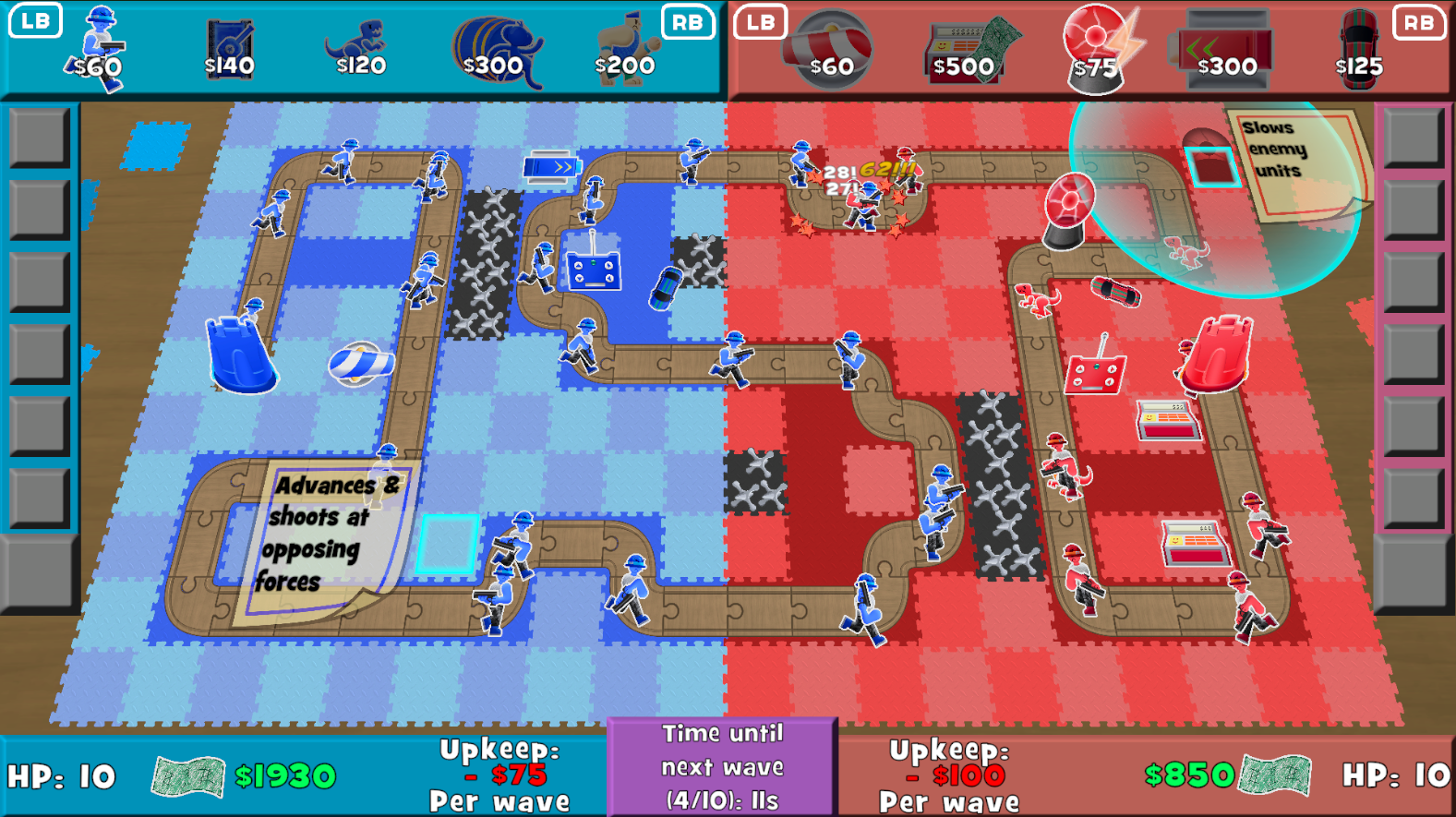
Early on we wanted to add local multiplayer, because a standard tower defense didn't have enough of a hook. What we ended up with is two players, two castles and one path. You place towers on your side, send toys down the path at the other player, and whoever wears the other castle down first wins. Knock out one of their towers and your unit moves in and takes it over.
The whole thing is set on a kid's bedroom floor. The towers and units are toys, the path is a toy train track, and the menus look like they were made from sticky notes, buttons and office supplies.
What I owned
- Project management: the task tracker, priorities and deadlines, repository access, and keeping the team pointed at the same game.
- Design documentation, from the core mechanic write-up through to the final GDD.
- Tower and unit design, along with the comeback mechanics.
- Art implementation. Another team member drew the frames, and I did everything else in the engine.
- The settings menu, volume sliders and audio mixer, and the pause menu.
- Running our playtests and turning the survey results into a list of fixes.
How we worked
We were the same five people as last year, so we already knew how each other worked. This time I changed how we tracked the work. I added a priority and a complete-by date to every task, plus a legend so you could read the sheet at a glance. I was just trying to create better flow and pacing for getting things into the game, so everything didn't come in right at the last minute.
We playtested three times: an internal test on February 18, then an alpha on March 25 and a beta on April 8 at the Progress campus in Scarborough. Every player filled out a Google Form. Connor, Jyden and I played alongside people, and Lisa and another team member watched how players were reacting and wrote down anything that wouldn't make it onto the form. After each one we put the results into a presentation: what's working, what's confusing, what's unbalanced, and what we're fixing.
It was all down to balance really. Each round we were trying to make sure there wasn't too much of a meta strategy.
One hard decision
The team had two passionate pitches on versus tower defense. Jyden's idea pulled from the versus modes in modern Bloons TD or Super Puzzle Fighter, where you each have your own field and send stuff over to the other player's. Mine was a real-time war of attrition where both sides' units meet in the middle and fight it out, closer to Dota Underlords, Totally Accurate Battle Simulator and Nidhogg.
We went with Jyden's idea. After all, he was the one who'd be building it as the programmer. We read all the rules back out loud the night before to make sure we knew what we were talking about and were confident we were at least going to make an interesting Tower Defense.
Then we pitched it. The class and Brian, our instructor, were confused by it, and the questions they asked were the same arguments I'd made in my original concept. After further fleshing out of the idea, we flipped the pitch to two castles on a shared path, units that fight each other in the middle, and towers you can take over the further you get to the other side. Thankfully we had 2 great ideas at the beginning which made it easy to adapt. By week 3 we'd also dropped a separate build and attack phase idea in favour of everything happening in real time, but eventually reincorporated a structured wave based system as time went on.
Ultimately I'm just glad we could make something we all felt good about in the end.
Outcome
- A finished, playable game on the Centennial Game Dev itch.io page.
- 106 of 110 core tasks complete.
- 14 of 16 alpha feedback items fixed, and 14 of 18 from the beta.
- Shown at the Gaming Garage at the CNE. Level Up happened before our semester ended, so we missed that one.
What I'd do differently
My relaxed managerial style this time around made it easier for others to lay back as well, when maybe we all (less Jyden, because he has no chill) needed a bit of a push.
There were no iterations for certain assets, like the thumbnails. They ended up being one and done, with no room for feedback or revisions down the line.
Next time I'll set out clear expectations from the beginning so everyone can be on the same page. While you may be able to trust them as people, that doesn't always apply to the work that needs getting done.
What did work was trusting others to get the work done by the end.
Picking the toys
Everyone pitched their own towers and units, and any mechanic more than one of us came up with went straight in. We capped it at five towers and five units so we didn't bury ourselves in art.
The ones of mine that got picked were the Plasma Orb, the Toy Car, the Baby Dinosaur, Wrestle Man and the Barrel of Monkeys. They got picked because they each had somewhat unique mechanics, and that gave me some interesting ideas regarding how they could fit into the theme. The Plasma Orb charges up and slows everything near it. Wrestle Man is slow and tanky, and shoves enemy units back up the path. The Barrel of Monkeys rolls down the lane and bursts into a handful of little monkeys that run straight past whatever's in front of them.
Giving the losing player a chance
Our internal playtest showed us how fast one player could run away with a match. I was thinking about Mario Kart and its rubber-banding. It never feels good to be completely dominated in a game, but it can feel good to still lose but feel like you had a fighting chance.
We ended up with two comeback mechanics. When you destroy an enemy tower, your unit takes it over and it starts shooting for you, so a push can turn around fast. And when a player gets low on HP, shortcuts open up on the path automatically.
Nerf sniper for the love of god
Those are our own words from our notes. Some playtests just ended up being build only sniper towers, because they can shoot across the map and pierce through enemy units, as well as attacking towers that can't reach them back. The sniper had 8.5 metres of range and went for towers first. Our ranged unit had 6, and the basic tower had 5.5.
We nerfed it after the alpha. At the beta, "the sniper is too good" was still the most common thing people wrote about towers, so it got nerfed again.
Doing the art in engine
The artist drew the frames, and I did everything else in the engine because she wasn't confident with it. That meant hooking up her animations and getting them playing in the game. Around week 9 I animated the money tower, the plasma orb, the soldier and the wrestler.
I also built the settings menu, with the volume sliders and audio mixer behind it, and made some tough decisions regarding the project's music. We were hoping to have some original music composed, but unfortunately we did have to pivot and go royalty-free once again, but I think it turned out pretty well. I took on the pause menu as well, so Connor could put their time into sound effects.
Three playtests, three different problems
Every playtest ended with the same Google Form. The table pulls four of its questions, each rated on a scale of 1 to 5, with the scores averaged for each session. Higher isn't always better, so here's what each end means and what we were aiming for.
- Fun: "Overall, how much fun did you have during the match?" 1 is no fun, 5 is a lot of fun. Higher is better.
- Rules clarity: "How clear were the rules and objectives of the game?" 1 is completely confusing, 5 is completely clear. Higher is better.
- Competitive feel: "How competitive and interactive did the battlefield feel?" 1 is like playing alone, 5 is a constant back and forth with your opponent. Higher is better.
- Match length: "How long did the match feel? (Too short, too long, or just right?)" 1 is too short, 5 is too long. We wanted the middle: 3 is just right.
| Playtest | Responses | First time playing | Fun | Rules clarity | Competitive feel | Match length |
|---|---|---|---|---|---|---|
| Internal, Feb 18 | 7 | 6 | 3.6 | 3.0 | 3.6 | 3.0 |
| Alpha, Mar 25 | 17 | 11 | 4.2 | 3.7 | 3.6 | 3.4 |
| Beta, Apr 8 | 11 | 3 | 4.1 | 4.3 | 3.4 | 3.6 |
Match length started right on target and crept a little longer each round. Most of the beta players had already played an earlier build, so some of that jump in rules clarity is people who already knew the game. The help menu did its part too. One beta player wrote that "conversion was a lot more clear this time due to the help menu."
35 responses across three sessions is fewer than the 46 we got from two sessions on Whispers of Hope. A lot of the programs at the Story Arts campus were shutting down, along with the campus itself, so there just weren't as many students around to play.
Internal: nobody knew what anything did
The core idea worked. People were having fun, especially once they were fighting over towers in the middle. One player said they "almost lost a match, but placed a bunch of towers once the 4th wave started and ended up winning."
The problem was reading the game. Players were placing towers without knowing what they did, and one wrote "As a non gamer none of it was intuitive." Once someone got ahead it snowballed, since "3 shooters insta convert a fresh tower." Players could also sit back, build up money, and send one giant wave. As one put it, "Large wave beats any strat."
Clarity became our first priority. We added a build queue with build times, so you can see what your opponent is about to send and nobody can dump a huge wave all at once. We also planned tooltips, a limit on conversions, and toy names instead of game mechanic names.
Alpha: fun, but too much at once
14 of 17 players said the visuals were clear, and the tooltips helped. "Lots of fun, the tug of war aspect is very fun." Everyone who noticed the build queue liked it. One player said it "felt like a real flash game I would've played with my brother a lot with back when I was little."
Tower conversion still confused people. One player didn't realize they could take over enemy towers, and it "ended up being pivotal to my opponent's strategy." This is also where the sniper and the cash register took over. Someone said the printer was "absurd" because it snowballed before enemies could even reach it.
After the alpha we added a wave timer, upkeep costs per wave and better tile detection, and fixed a stack of bugs. Then we started on the sniper and cash register nerfs, a stat rebalance and a how-to-play screen.
Beta: money ran the game
Most of the beta players had played before, and it showed. They picked a playstyle quickly, kept coming back for another round, and talked trash while they did it. "I have a pretty consistent line of money." "I'm gonna place a line of cheap towers in the front for fodder."
That money was the problem. Cash registers were the way to go, towers were doing way more than units, and players said to "make more emphasis in the units." People were also mixed up about which side they were on, partly because of a bug where converted towers shot at their own team: "We're not on the sides we think we are."
We fixed that bug, nerfed the sniper again, added a surrender button to end matches, and fixed a bunch of smaller issues. A few bugs we couldn't recreate, and some animation fixes got cut for scope. If we pick it up again, the next steps are clearer team sides, a clearer explanation of conversion, toning down the economy, and a mouse-controlled single player mode.